The term “AI” is everywhere, promising a revolution in how we do business. But for B2B eCommerce leaders, the central question isn’t what AI can do in theory, but how it can solve today’s pressing challenges.
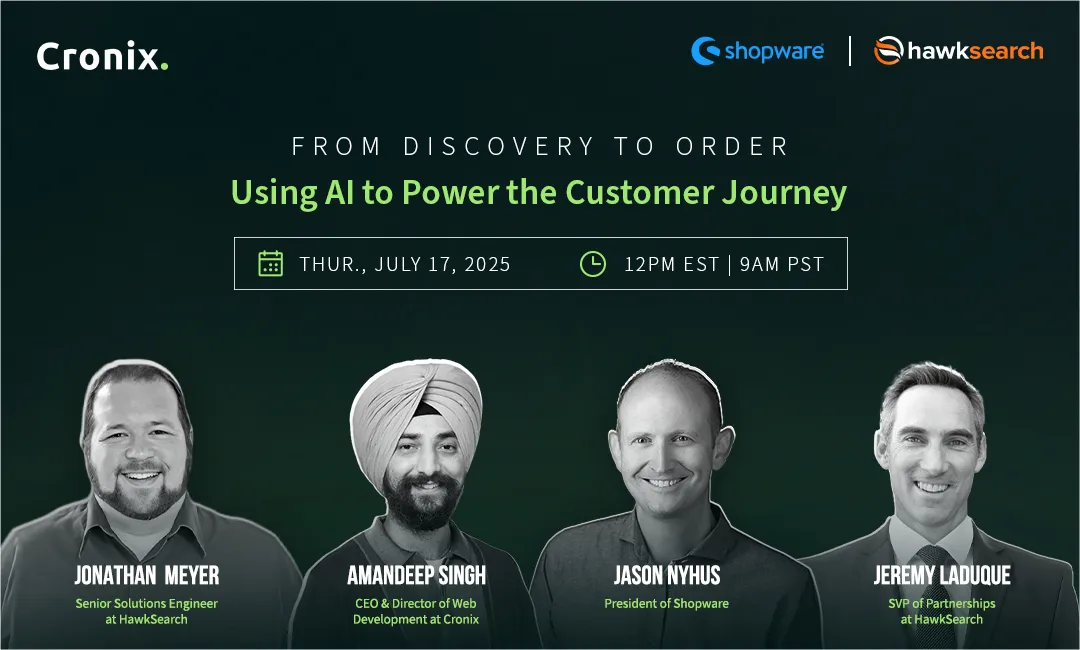
The practical perspective to drive real-world growth was the focus of a recent webinar, “From Discovery to Order: Using AI to Power the Customer Journey,” hosted by our partners at HawkSearch on July 17.
As the team on the front lines implementing these advanced technologies, we at Cronix were delighted to witness our CEO, Amandeep Singh, share his insights.
In this blog, we provide the essential takeaways from the conversation and explore how AI is reshaping B2B eCommerce.
Meet the Experts
The panel brought together a trifecta of industry leaders and our own Founder, Amandeep Singh.
- Amandeep Singh | CEO & Director of Web Development, Cronix: With over 15 years of experience architecting high-performance solutions, Amandeep provided the indispensable practitioner’s viewpoint, sharing how engineering and strategic integrations lead to business success.
- Jason Nyhus | President and GM, Shopware US: He is a leader with two decades of experience driving global growth for technology giants. Jason articulated the high-level vision of how core commerce engines are evolving to help B2B brands scale and compete effectively across every channel.
- Jonathan Meyer | Senior Sales Engineer, HawkSearch: Jonathan excels at demystifying complex technology. He offers clear demonstrations that show businesses exactly how next-generation search solutions can solve their biggest challenges.
- Jeremy LaDuque | SVP, Partnerships, HawkSearch: Drawing on over 20 years in digital commerce and SaaS, Jeremy masterfully connected the dots between platforms and technology that drive the industry forward.
AI as a Necessary Release Valve
Jason Nyhus of Shopware noted that B2B companies are navigating “a tremendous amount of headwinds,” including tariff wars, inflation, and supply chain disruptions.
Hence, the primary role of AI is to reduce the cost and complexity of commerce. It can help manage the manual, repetitive tasks that consume the time of skilled professionals and automate them.
Teams can use the saved time on strategy, customer relationships, and innovation. As a result, talented sales representatives can become more efficient.
Manual Grind to Intelligent Automation
Theory is one thing, but practical application is where value is created. Amandeep Singh provided a ground-level view of how Cronix is applying AI to solve tangible business problems that plague B2B companies.
Redefining the Sales Funnel
One of the most striking examples shared was a solution for lead-gen drop-off. “A client was facing issues with leads going cold,” Amandeep explained. “If a form was submitted after hours, the lead would wait until the next day.”
As always, Cronix’s team came up with a solution and deployed an AI-powered agent that engages the lead immediately. The moment a form is submitted, the AI agent can initiate a call, ask qualifying questions, and gather initial requirements.
This not only ensures 24/7 responsiveness but also delivers a more qualified, pre-vetted lead to the sales team the next morning.
Streamlining Complex B2B Orders
Another powerful use case Amandeep highlighted came from a B2B client in the architectural supply space. Their customers, architects and designers, work with complex design documents (PDFs). The old process required them to manually search for dozens of individual SKUs within the document.
Cronix is currently building a system where AI parses the document and automatically populates a cart. This moves the customer from discovery to order in minutes, not hours, in a friction-free process.
The Rise of AI Search
A customer can’t buy what they can’t find. As B2B catalogs swell to hundreds of thousands of products, traditional keyword search is no longer sufficient. Jonathan Meyer from HawkSearch detailed the evolution of search, a shift which is a top priority for nearly every B2B business.
The modern search experience is a hybrid model that understands customers on their terms.
- For the user, it instantly recognizes precise part numbers.
- For the sales rep, it can interpret natural language questions.
- For the field technician, it allows them to simply take a photo of a part and find a match through visual search.
This multifaceted approach is powered by semantic understanding and vector search. It ensures that every user, regardless of their level of expertise, can find the right product for their needs.
Ensuring Data Purity, Privacy, and Performance
Every AI function relies on one fundamental element: data. The panel unanimously agreed on the classic principle: “Garbage in, garbage out.” This is perhaps the biggest hurdle in B2B, where product data often comes from hundreds of different vendors in inconsistent formats.
Moreover, AI tools like ChatGPT, Gemini, Perplexity, Claude, etc., come with major concerns like privacy and hallucinations.
However, leaders like Shopware and HawkSearch are building enterprise-grade guardrails to ensure client data remains proprietary and doesn’t train public models. Furthermore, they lock their generative AI tools only to use a client’s own verified product data.
Therefore, they eliminate the risk of the AI “hallucinating” and suggesting a competitor’s product or providing false information.
Cronix: Your Trusted B2B Partner on the AI Journey
B2B eCommerce is evolving into a space where intelligent agents automate workflows and data is a powerful asset. For those who missed it live, you can watch the uncut recording of the webinar, “From Discovery to Order: Use AI to Power the Customer Journey” on YouTube.
If there’s one thing we learned, it’s that no business succeeds in a vacuum. The challenges of B2B digital transformation are best met with the support of peers and eCommerce partners. If you’re a B2B leader ready to succeed, we invite you to connect with Cronix and our team of seasoned B2B experts.
The AI revolution is here.
So, partner with Cronix, a team that is not just discussing the future, but actively building it.